Showing posts with label PDSA Cycle. Show all posts

Friday, April 19, 2019

Toyota Kata

This is a continuation of the last post dealing with the training methods taught to Japan by the U.S.'s Training Within Industry after WWII. As explained in that post, the three TWI J-courses had a major influence on several of key concepts of the Toyota Production System, namely Standardized work, respect for workers and continuous improvement. But, true to Toyota’s character, they took that information, put their own “flavoring" on it, and developed what Mike Rother calls Toyota Kata.

Kata comes from  the world of oriental, martial arts. It means “form.” There are two primary kata; Improvement Kata and Coaching Kata.


Toyota Improvement Kata


When we think about the distance between where we are currently and our True North (or any other challenge), it can seem immeasurable. Or, the idea of a Lean transition and all that that entails can seem overwhelming. But, handling these emotions comes down to the metaphorical concept of how to eat an elephant; one bite at a time. Improvement kata is the standardized work for taking each bite.
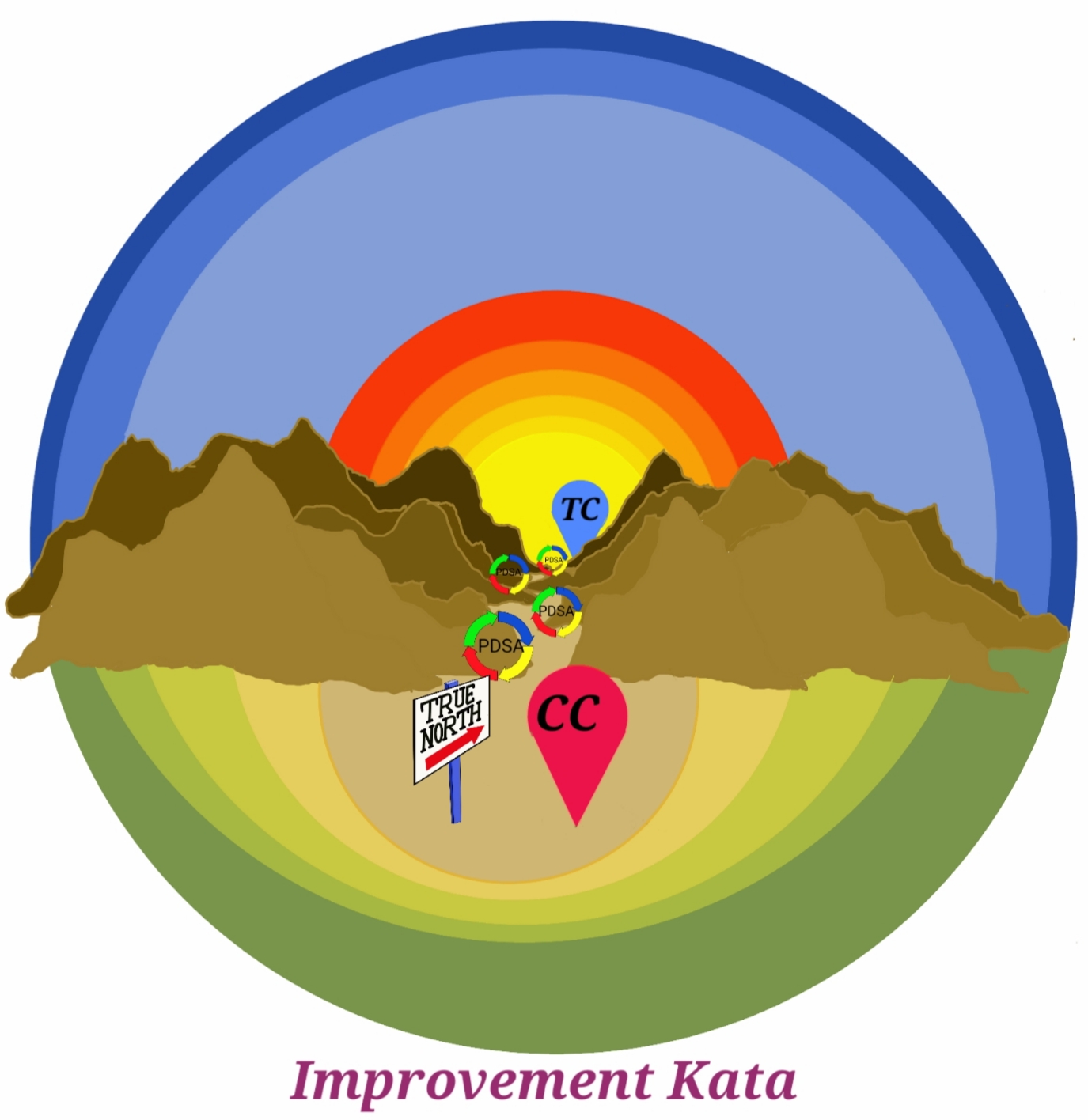


The first step is to have a good understanding of where you are going; your direction, your True North or the challenge before you. In the figure above, “CC" stands for our current condition and “TC" is the target condition. The target condition is what we feel is the next logical step on our journey to True North or our goal. Part of the journey to our next TC is clearly visible and we have a very good idea how to get that far. But, after that, there is the part that is less knowable. It is more obscure, intimidating and without a clear plan. So, how do we get through this part of the quest? We PDSA our way through it.

We make a plan, experiment and see if we get closer to out target condition. The path that this takes us on is not necessarily straight. There will probably be some “zigging" this way and “zagging" that way, but through the use of A3 thinking, we will reach our TC. One bite gone! Eventually, by continuing to identify each next successive “bite" (target condition) and repeating the process, we get closer and closer to our goal. This is the essence of the Improvement Kata.


Toyota Coaching Kata


As the name implies, the Coaching kata is the standardized work for managers to mentor and monitor individuals and groups involved in improvement kata. It consists of five questions:
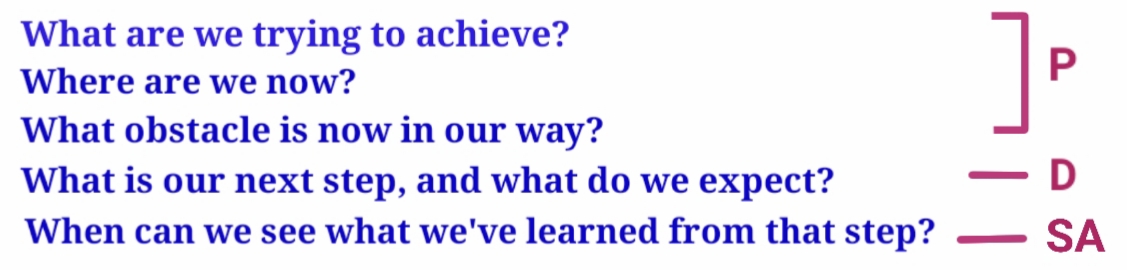


As you probably can tell, these questions are simply asking the group to visualize and verbalize the PDSA cycle.

  1. Where are you trying to get to? What is your direction or challenge and what is your next target?
  2. What is your current condition? Where are you now?
  3. What is one thing that is keeping you from reaching the target? What are the problems? If there are more than one, then deal with this one now, and come back to the others later.
  4. What countermeasures are you going to try and, if successful, what will that future state look like?
  5. When can we study and evaluate that experiment?

You may have several groups, each trying to reach the next target condition of their improvement project, but for you, as the coach/mentor, the questions remain basically the same. Rather than solving the problems for them, you are asking questions that will lead them, through A3 thinking, to solve their own problems, learn, and deeply understand the process. Coaching is a scheduled, periodic endeavor, much like Lean Daily Management, but less frequent. We are monitoring that the project is on task and progressing appropriately.


Thanks for reading. Your comments, suggestions, ideas and questions are always appreciated.

Tuesday, February 26, 2019

A Different Kind Of Rounds: Lean Daily Management

As doctors and veterinary staff, we are well acquainted with the daily ritual of morning or change of shift medical rounds. This is the gathering of hospital staff and doctors to be updated on the current status of all of the patients in the hospital for treatment, and for the dissemination of new treatment orders by the doctors in charge. This is a form of standardized work. It gets everyone on the same page in a routine and timely manner.

Lean Daily Management (LDM) serves the same purpose, but for the operations and management side of the practice.


Each morning, leadership and management go to the gemba to meet with staff of a particular area of the practice to go over that area's board. What numbers are up (and why?) and what numbers are down (and why?). Or, better yet, do the Process Behavior Charts (PBC) of the data show any "signals" or is it all just "noise?" (see also Mark Graban's book "Measures of Success") What countermeasures should be tried? Any new kaizen ideas? What, if anything, can management do to support the staff? Any evidence that standardized work is not being followed?

Sidebar: One of the two Process Behavior Charts above is showing two signals. Can you identify which chart it is and what the signals are?

LDM helps support our progress through that big PDSA cycle called hoshin kanri or strategy deployment. Remember, part of the Act (/Adjust) phase of a successful PDSA cycle is to sustain the results (for now), write new standardized work, scale up if appropriate, and start teaching to the new standard. This brings a new current state, and the next target condition is identified, initiating a new PDSA cycle of improvement.


In the figure above, the wheel has been moved up the ramp (improvement) through A3 thinking and kaizen. But, there are forces in any system that want to undo that which has been accomplished. Some call it entropy; I think of it as organizational gravity. The function of standardized work is to counter those evil forces by stabilizing and sustaining the new current state.

The role of LDM is to sustain and stabilize ("nail down") standardized work as it is currently written. LDM functions as a "checks and balance" for standardized work, which acts as a wedge to help prevent organizational backsliding. LDM is the setting aside of time on a daily basis to monitor for this potential.

So, to recap, standardized work sustains the current state, and LDM sustains the current standardized work.

Lean Daily Management meetings should take 10 to 20 minutes per day. They are typically done in the mornings, however, they need to be a scheduled, daily priority for all involved. Choose the time that’s best for your practice and team.

All extraneous interruptions should be put on hold for the entirety of the time. During the meeting, a staff member from the department or area of the practice, such as the Hospital Care team, quickly reviews the metrics, status of any countermeasures, new problems that have come up, any cross training efforts, new and ongoing kaizen, etc. with management. The staff member that leads the meeting should rotate from amongst the entire team, so that everyone gets the opportunity to lead the conversation and learn.

As is the Lean perspective, management takes on a teaching and mentoring capacity; asking questions to stimulate A3 thinking, encouraging all efforts and practicing servant leadership.

So, Lean Daily Management accomplishes several things:
1. Gets management to the places where work occurs (go to gemba)
2.  Facilitates conversation and consensus building with staff
3.  Demonstrates management's commitment to the staff
4.  Monitors the metrics that support the True North statement and KPIs
5.  Allows time to encourage and appreciate kaizen efforts
6.  Sustains and audits standardized work
7.  Creates increased engagement of the workers
8.  Show respect for workers


Thanks for stopping by. Comments, questions, and suggestions always welcome.

Also, to answer the sidebar questions, the bottom PBC is showing a signal that needs to be investigated. The first signal is the data point above the upper process limit.The second signal is three or four of the last four data being closer to one of the process limit lines than the average. In the case above, the last five data points are closer to the lower process limit line than the average. In fact, it appears that we may be trending around an entirely new, lower average, which indicates that the whole system has changed somehow. Both of these conditions should have been recognized earlier than now, if they weren't. The next step is root cause analysis and formation of countermeasures, i.e. PDSA problem solving.


Sunday, February 3, 2019

The Origins of Lean are Not All Japanese

Over the past few years, while discussing what Lean is with people, I have had one or two of them make comments to the effect that they weren’t interested in learning about anything coming from Japan (or any other foreign country!).

Now, while it is true that Lean did come from Toyota via the Toyota Production System (TPS) and Toyota developed this in Japan, much of what originally went into it came from the good ole' U.S. of A.

There were four primary entities from the United States that had an influence on and are responsible for a very large part of what came to be TPS. They are:

1. Henry Ford and Ford Motor Company
2. W. Edwards Deming 
3. Training Within Industry (TWI)
4. 1950s U.S. grocery stores


Henry Ford

The first influence came from Henry Ford's idea of the assembly line and mass production, allowing the increased manufacturing of identical products by several orders of magnitude. 

These concepts included highly standardized parts, which also allowed for the quick replacement of defective parts with identical replacements, which saved time. But, the mindset was still based on inspecting and repairing defects after the fact instead of preventing defects, as Toyota had already been focusing on. 

Not to mention that most of these defects weren't caught until the whole auto had been built, so sometimes it was just as easy to scrap the car altogether. 

But, what the heck! America was victorious after the war and had plenty of returning workers and plentiful resources. What’s a few thousand defective products and the time and labor to fix the situation? Japan was a defeated country with a scarcity of resources, which required them to be more creative.

Toyota, as well as the rest of the world learned from Ford as he started the mass production assembly line. However, they would tweak it quite a bit in the years to come. And, others would learn that Lean applies in environments that are not moving assembly lines.


W. Edwards Deming 


In recent years, a Toyota executive said:

"There is not a day I don’t think about what Dr. Deming meant to us. Deming is the core of our management.”

W. Edwards Deming was an engineer, mathematical physicist, and statistician during the twentieth century, becoming one of the greatest quality gurus of all time. In 1947, Dr. Deming was asked by the United States to go to Japan to help with the census during the post war restoration efforts. While he was there in that capacity, he gave a series of lectures on quality and process control to the Japanese Union of Scientists and Engineers. They eagerly incorporated his material into their thinking. The Deming Prize is still given out in Japan for examples of the highest quality organizations.

The PDSA (or PDCA) cycle is also known as the Shewhart cycle (or the Deming cycle)

From Dr. Deming, Japan and Toyota learned about building quality into the product at the gemba, the PDCA cycle and systems thinking.


Training Within Industries (TWI)

When the United States decided to enter World War II, most all able bodied men were ushered into military service. This left a large deficit in the workforce population, especially at a time when the military industrial complex was gearing up. In order to replace this workforce, women were recruited to fill these positions. Think of “Rosie the Riveter.”


The problem, of course, was that these new hires had little to no training in industry. Because the need was so immediate, the war department started the Training Within Industry (TWI) program.

Training Within Industry was a predominately volunteer program to help get new workers up to speed as quickly as possible. Many of the TWI trainers were loaned to the project by manufacturers, which continued to pay their salaries.

No manufacturing company was forced to utilize the TWI program. They had to request TWI help, and many did. There were also cases where TWI was used in healthcare.

There were four training programs offered at different times called the Jobs programs. These included the Jobs Instruction (JI) course, the Jobs Methods (JM) course, the Jobs Relations (JR) and, later, the Jobs Safety (JS) course. 

The program was very successful and contributed greatly to the United States being among the victors. When the war was over and the United States was helping to rebuild Japan, the TWI programs were exported. Manufacturers, including Toyota, enthusiastically incorporated the concepts into their own cultures. There is still a copy of an original TWI manual in the Toyota company museum. 

Once the war was over, the War Department ended the TWI program, the men returned to their jobs, the industrial revolution was on its way, resources were plentiful, manufacturers didn't see the need of TWI in their companies and interest in TWI dwindled to almost nothing. In recent years, however, there has been a renewed excitement in the old programs and methods.

The TWI Job Instruction (JI) course
This course was designed to teach supervisors how to teach new workers. These people knew their jobs well and had a lot of experience, but many didn't understand how to teach someone else. This course showed them how to dissect the job into its individual steps and provided them with a standard way of instructing on a step-by-step basis. This was the nidus for TPS's standardized work.


Training cards (as shown above and below) for each of the “J" courses were given to students to constantly refer to when dealing with their workers at their jobsite. This was necessary to protect the uniformity and integrity of the material throughout the project.

The TWI Job Methods (JM) course 


Job Methods taught how to improve the work being done. It was the impetus for kaizen or continuous improvement.

The TWI Job Relations (JR) course


The Job Relations course instructed supervisors how the deal with interpersonal relationships and conflicts. Toyota's commitment to the respect of workers and people came from this information.


These early concepts eventually evolved into Toyota's Improvement Kata and the Coaching  Kata. These are the standardized work of how managers and supervisors teach and mentor their direct reports.


1950s United States Grocery Stores 

Toyota executives who had come to the United States to observe and learn were intrigued by the way our grocery stores replenished their shelves at night with only those items that had sold that day. By the next morning, when the store reopened, the shelves were full for customers to purchase and the cycle repeated. 

Very little inventory was kept in the back of the store which cut down on costs to warehouse a large inventory and the capital tied up in that merchandise. All of this appealed to a small company in a small, recovering country. Just-In-Time thinking was born from this U.S. grocery store concept


While there is definitely an Eastern philosophical hue to the Toyota Production System, the roots of much of the mindset, especially what we would consider the major concepts, originated from the United States. But, keep in mind that Toyota is not the same as every Japanese company. They've worked hard to create a special culture -- they've been willing to learn from other countries. How about you?


Thank you for stopping by. Comments always welcome.


Wednesday, November 7, 2018

Lean Veterinary Strategy Deployment (Hoshin kanri)


Hoshin kanri is a Japanese word for strategy deployment. It literally translates to mean “compass management.” It is the process of introducing and aligning the organization’s True North vision down through managers to the frontline staff. It consists of a series of PDSA cycles complete with consensus building (nemawashi) and playing “catchball” along the way.


The first PDSA cycle is undertaken among leadership. It is here that the concept of True North is defined along with the four to six (typically) high-level focus areas and their metrics

When looked at as a whole, these few focus areas should completely define your practice. In other words, monitoring the metrics of the focus areas should give you a high-level indication of how the practice is functioning. If these metrics are improving, then the practice should be improving, also. The lower level metrics will compliment these metrics by highlighting the more detailed processes.

This a true PDSA cycle in that all of the stages (Plan, Do, Study, Adjust) are completed and what is eventually chosen is not written in stone. It is an attempt at alignment; high-level standardized work. It is an experiment. If the True North statement turns out to be inadequate in some respect, then leadership simply adjusts and starts a new cycle. A3 reports can follow the process in order to keep stakeholders up to speed.

The second cycle is between leadership (Owners, C-suite, etc.) and supervisors (lead receptionist, lead surgery techs, lead hospital tech, lead groomer, lead boarding tech, etc.). Again, consensus building is of prime interest. This is not the typical management philosophy of “command and control.” It is a typical Lean “bottom-up” endeavor with "catchball" input from leaders. Leadership introduces True North focus areas to the supervisors and, then, mentors and coaches them in order to help them to decide what True North would look like at their level.

and what processes they'll need to monitor in order to help ensure the top focus are metrics are positive. Again, this may be subject to adjustment after a period of experimentation. A3 reports are kept current.

The third cycle is between the lead staff and the frontline workers. It proceeds similarly to the cycle just described.

So, what we now have is is an overall alignment of the practice from leadership through lead techs down to frontline staff. How that looks and what metrics are monitored will vary based on the the different areas of the practice. 


For example, we might have a True North focus area of "Processes Improvement." This applies to everyone. However, at the lead and frontline level, the metrics are different between, for instance, receptionists or exam techs or surgery techs, etc. Their metrics will be determined by what that focus area means to them from their perspectives. 


If all of this is successful, then everyone, from leadership to frontline staff, should have a hold on the same rope, on the same end, pulling in the same direction and at the same time...and winning!


Mark Graban's 4 Hypotheses of Strategy Deployment

Mark has described strategy deployment as a series of four hypotheses in a series of two blog posts - here and here:
 1.  If we focus our improvement efforts and close performance gaps in our four or five True North areas, we will therefore perform well as an organization, this year and into the future.
For example, if we choose Client education, Staff development, Community involvement, Fiscal responsibility and Hospital improvement as our five True North focus areas, then we posit that if we are successful in these areas, the practice as a whole will be successful. In other words, these five areas are the best five areas to monitor in order for the overall practice to be successful. 
Remember, this is your True North statement with your focus areas for your practice with your staff and clients. 
Is this the right True North? We don't know.  But, we will start with these and experiment. If it is determined these are not the best five, we can adjust them and try again. Just like treating our patients. If one diagnosis or treatment is not working, then we “back up" and try again
What are the four or five focus areas that make up your True North and that, if successful, will results in a high probability that the hospital/clinic will be successful overall.
   2.   If we can improve and close our performance gaps in these key performance indicators, we will satisfy our need for improvement in our key focus areas, and therefore will be successful as an organization, overall.
What are the metrics (two or three per focus area) that will show that our focus areas are heading in the right direction (which, in turn, indicates that the whole practice is headed in the right direction).
Are these the right metrics? We don't know, but we'll try them for a while and then evaluate our decision. If they are the right metrics, why? If they aren’t, why not? It is important to deeply understand both of these scenarios in order to learn.
Are these metrics still relevant to your organization and staff?
3. If we actually execute and complete these top X initiatives,  projects, events and A3s, then we will make the greatest strides toward closing the key focus areas (Hypothesis  2) and therefore we'll be more successful in our strategy.
Not everything can be a high priority. It is easy to get sidetracked and pulled off task. You have already prioritized in the last hypothesis. Stay focused. Close the performance gaps in these focus areas in order to get the greatest gains, then you can start over with other focus areas. Err on the side of too few initiatives (so you can actually get something accomplished), rather than too many (and none of them get done or done right). With experience and reflection, you will get more accurate in choosing the number of areas you can tackle without the whole team becoming overburdened. 
4. We actually have the organizational capacity to complete these top X priorities in a year or a given timeframe (and with the right quality).
Do we have the capacity in terms of personnel, resources and capital to actually accomplish these priorities in a timely fashion? If not, then either we obtain them or deselect this priority in favor of another one that can be accomplished at this time.

Get book!


Thanks for stopping by. Please mention us to your like-minded friends and colleagues. 

Sunday, June 3, 2018

The Law of Interconnected Waste

I have been reading (re-reading) Lean Daily Management for Healthcare by Brad White. I was very impressed by the book the first time through, and am learning even more this time. This excerpt from the book concerns the relationships between waste, value, your staff and financial rewards. Thank you Brad for permission to post this material.


This law states that all the process waste of an organization manifests itself in three ways: 


1. Reduced value to the customer 

2. Reduced satisfaction to the employee 
3. Reduced profit to the company 

This law offers some very powerful results from attacking waste. First, one of the best ways to increase value and quality is not to spend more money but rather to eliminate the waste and friction in your processes that sap value during production. Second, eliminating process waste will increase profits by reducing expenses. (There may very well be an increase in demand and quality. That, though, is more of a marketing issue. The key observation here is that it costs money to produce waste. Any reduction in that waste results in less money that is spent on producing it.) Third, reducing process waste will increase the happiness of employees. This final point is vitally important to the success of a Lean management system.


The Law of Interconnected Waste
Taken together, these three points reveal that there is natural alignment among employees, patients, and finances. We can leverage this natural alignment by tapping in to the current frustrations that our people have regarding the workplace. Thus, one of the best places to start when seeking to eliminate waste is to simply ask your staff. 

What frustrates you about your job? 


Any frustration they have about the daily operation of their job will invariably lead back to a process waste that impacts patients and drains resources. The management system you build will be able to take these raw frustrations, convert them into hard metrics, and then use the scientific PDSA problemsolving to drill down to the root cause. 


This is the secret to gaining employee buy-in. By tapping in to the simple fact that people prefer to do the job that they were hired to do, and that, all else being equal, they prefer to do it well as opposed to poorly, you can leverage their expertise to sniff out waste from the bottom up. Also, because your staff are constantly connected to the customers, they will naturally steer the organization back toward a customer-centric model because, like a horse that naturally follows the path since walking is easier, they prefer to be highly productive with lots of patient contact because that is why they entered the field in the first place.


                                       *****************************************


FYI: I am writing a book!


I am writing a book explaining the Lean mindset and processes from a veterinary perspective (the first of its kind!). In it, I will be emphasizing the similarities between the scientific methods of diagnosising a pet with a disease and scientific methods of using Lean to fix veterinary practice dis-ease. I am very excited to share this information, especially with my colleagues and profession. Stay tuned for updates .


Thank you for stopping by. Please tell your friends about this blog. Remember, comments are always welcome.

Thursday, September 21, 2017

A Lean Staff Meeting Micro-experiment

The Lean philosophy is built largely around the concept of problem solving and continuous improvement (kaizen) by involving the workers who do the work on the floor (gemba) day in and day out. The idea is to foster and coach (working together) problem solving with them (bottom up), rather than telling them what to do and how (top down). Kaizen is the essence of what we strive for when we build teams or imagine when we use the term “teamwork”. 

The results of all of this are:

  1. Many vs. a few minds working to solve the problem.
  2. Identifying more problems.
  3. Better determination of the root cause(s) of the problem(s).
  4. Fosters the Lean concept of a leader/manager being a teacher as well as a supervisor in problem solving.
  5. Shifts some of the frustration of management off our "plate" (without losing responsibility).
  6. By involving staff in this process, it shows that we value and respect their input.
  7. Engages staff in the practice.
  8. Increases their value to the practice. Their value appreciates over time.

So, with all of this in mind, try this micro-experiment with your employees (team) at your next staff meeting by taking a more Socratic approach to problem solving (teaching through questioning rather than lecturing).

The Micro-Experiment

  • Chose or a elicit a small, non-crisis problem to work on.
  • Communicate that this is a safe environment and a "Judgement free zone.” Everyone is intelligent and has ideas to contribute.
  • Place three coins in front of you. You are allowed three declarative statements during the staff meeting. If you make such a statement, then remove a coin. All other statements need to be in the form of open-ended questions.
  • Think in terms of system failures, not people failures.
  • Ask lots of “Why?”s, “How?”s and “What makes you say/think that?”s, not “Who (is to blame)?”s
  • No leading questions like “Don't you think it would be better to do _______?” You are not trying to 'manipulate' them into arriving at a solution you've already decided on or simply making it seem like they are participating. This is truly listening to their ideas and honestly involving them in finding possible solutions through concensus (nemawashi).
  • Praise participation.

Remember back to when you were learning how to diagnose and what questions to ask and how? Formulating a list of deferential diagnoses and, then, trying to arrive at a definitive diagnosis. It is basically the same process that you are trying to teach your staff about, except instead of a pet with a problem, we are dealing with a practice system, process, flow, and/or communication problem.

It won't work perfectly the first time. This is completely different than how most staff meetings are conducted. Look for small successes and then build upon them. With enough coaching and practicing, one day your staff may identify a problem, find its root cause and decide, together, on a viable solution to try, collect the results and plan the next step with little more than oversight involvement from you. Can I get a “Hallelujah!”?

Let me know how it went. Did your staff surprise you with their deep understanding of the issues? Were they more creative than you expected? Did they have a more realistic perception of the actual problem and root causes than you? How difficult was it for you to teach by asking questions? What did you learn? What would you change the next time? Could you cut back to two coins? One?

Thanks for stopping by. Please tell your friends, staff and colleagues about the blog. Comments and questions always appreciated.

Thursday, June 8, 2017

Lean and Veterinary Medicine: Like a Glove


After reading, studying and thinking about Lean over the past seven years, I am convinced that Veterinary practice and Lean are destined for each other. As veterinarians and systematic problem solvers, we already know and are familiar with over eighty percent of Lean; we just don’t know it. Lean promotes greater value for the customer (from the customer’s perspective), with higher quality, better utilization of all resources  (especially our human resources), less expense and increased engagement of staff. I think most veterinarians want the same things.

Lean is the Western name for the Toyota Production System (TPS). Coined for its ability to remove the “fat” (wastes or muda) from processes.  Toyota developed TPS in an effort to rise out of war torn Japan, with its limited resources, to be able to go beyond truck manufacturing for the small, Japanese economy to complete with the American auto giants in a global economy. Since then, most other industries have found successes with Lean, including human healthcare. Can it do for veterinary medicine what it has done for many hospitals and healthcare system around the world? I think it can and that we need to try.


We’re Not That Different, Really

First of all, Lean takes a systems approach to problems. Problems are examined from a systems breakdown perspective before people are blamed. Lean asks “Why did this happen?”, or “How did this happen?” as opposed to “Who is responsible?” As doctors, we work with systems in our patients every day. We understand inputs, outputs, delays and feedback loops, both positive and negative. We know what can happen when one system is changed and how it can affect other systems for the better or the worse.

In order to identify the abnormal, we must first understand what is normal; what is ideal for this species, breed or animal. In veterinary school, we learned normal anatomy and physiology before we studied pathology. The same concept is true for Lean. We must have a very clear idea of what our ideal practice would look and function like. Notice, that I did not say an ideal practice. Lean is not trying to make your practice some management guru’s idea of the perfect “cookie cutter” practice. Lean understands that your practice is unique. The doctors are different. Their biases, philosophies and perspective are unique. The neighborhood where your practice is located is different than other neighborhoods. The mix of your employees is one of a kind. The Lean objective is to make your practice the best “your” practice it can be, now and into the future.

In the Lean mindset, this ideal is called our “True North.”  What would your practice look like if it was perfect? How would your practice perfectly relate to your clients? What would your ideal staff look and function like? How would your practice benefit your neighborhood and community if it is was perfect? It’s totally up to you. What ever you decide your True North is, Lean is designed to get you there. Forget, what a “Top 100 Best Practice” says you should be. What is important from the Lean perspective is that you are closer to your True North today than yesterday; closer this month than last month.  The perpetual destination of the Lean journey is perfection, knowing full well, of course, that this is impossible. The Lean journey never ends. As Vincent Lombardi said, we pursue perfection, knowing we will never get there, in order to reach excellence.


We Know This

As veterinarians, we are already quite familiar with eighty percent, or more, of the Lean methodology. We just don’t know it. Both mindsets are based on the scientific method of problem solving.

When a sick pet comes into our practice, health is our goal, our ideal state. The first step in diagnosing that pet is to understand fully the current state of that patient. We start with the primary client complaint. Regardless of whatever else we discover, we want to make sure we address this problem. Next, we collect a complete history; vaccinations, diet, current medications, symptoms and their progression, etc.

The second step is to perform a complete “tip of the nose to tip the tail” physical exam, paying particular attention to the client’s primary complaint. Can you imagine trying to make a diagnosis without performing a physical exam on the patient?

Next, we might perform diagnostic tests, such as a complete blood count, a general organ profile, urinalysis, radiography, and specific serology tests. We are attempting to explain why the patient is having the symptoms it is having. Medicine is based on facts, objective data, not fantasy.

At this point, we should have a reasonable understanding of the pet’s current state of health. Now, because we know what the ideal state of health is for this species, breed, gender and age, we can identify the problems; the gaps between our patient’s current state and the ideal state.

Based on our problems list, we formulate a treatment plan. This is an experiment. We don’t know if our treatments will work, but we decide, maybe with consultation with colleagues and specialists, what we are going to do. Later, we will follow up with the client and pet in order to analyze if we were successful  at reaching our ideal state of health. If we were successful, we will set a time for the next review, maybe in six months or a year. Remember the 3Rs; Recall, Re-examine or Reminder? If we were not successful, we reflect on what went wrong and start the process over again with additional history, another, possibly more in depth, physical exam, additional tests, a second, adjusted round of treatments (another experiment) and another analysis of the outcome.

As I said, the Lean methodology of management problem solving is also based on the scientific method. The process is almost identical to the one described above for diagnosing and treating sick pets. So how do we know we have problems? Because we have not reached our ideal state in one form or another.

The first step in Lean problem solving is to thoroughly define and understand our current state, just as it was with our patient. This step might include past and current metrics; key performance indicators. What is our story? “The facts, ma’am, only the facts!”

Defining the current state also includes an essential “physical exam.” In Lean, this is called “going to gemba.” Gemba is the Japanese word for the work floor, the place where the work (and problem) actually occurs. For instance, if the problem has to do with surgery, then the surgery room is the gemba. Lean emphasizes the importance of physically observing the flows and processes (the “value stream”) in real time in order to deeply understand the current state as it really is. A big difference in the Lean mindset, however, is that this observation (physical exam) should take place with the staff that are there on the floor, because they know better than anyone what the real issues are. They deal with it every minute of every day. They are an organization’s most valuable asset and resource, especially for helping to identify and provide solutions to problems. Lean promotes partnering with employees in this effort. Our staff wants to be part of the process of finding solutions, rather than always being seen as the cause of problems. This is a big part of what engages them.

Now, as in the diagnostic process, we can identify the gaps between our current state (disease) and our True North (health). However, many problems can appear to be caused by a particular cause when, in fact, it is caused by something much deeper; something more basic. Just as not diagnosing and treating the real problem versus treating symptoms will probably not yield a cure for or patients, not solving problems at their root cause will not provide a permanent solution to the problem at hand.


So, in Lean there is a “diagnostic” called “5 Whys.” This is the idea that one should ask “why” five times to insure the root cause has been identified. A fix for anything less will not solve the problem once and for all. The number five is somewhat arbitrary. It could be four or it could be seven. The idea is to ask enough times that the root (absolute) cause has been identified.

Does it ever seem like you are having to deal with the same problems over and over again? As if you are constantly playing the game “Whack-A-Mole?” As soon as you think a problem has been squashed in one place, it “pops up” again somewhere else? One of the main reasons for this could be the fact that the root cause (the definitive diagnosis) has not been found (another reason could be that your unique, valuable and knowledgeable staff played no part in the process). That it has always only been handled with “Band-Aids.” And, all of this effort is found to be just a waste of time and effort.

Once we know the gaps between our current state and our ideal state, we, in dialogue with our staff,  can devise the counter measures (treatments) we feel are indicated. This is an experiment, also, since we don’t know if it will work. It will give us an idea of what the future state should look like. Since our True North, or ideal state, is perfection, and we know that is impossible,  then the best we can do is aim for the next, improved, future state. Lean is a journey that never reaches its final destination of perfection. It is the process of continuous improvement toward ever better future states. We can never reach our True North, but with constant effort, we can get really, really close!

The final step, as with our patients, is to study the results of our tiny experiments. If the results are positive, then we institute it as the new, best method or standardized work and the staff is trained to this new current state. We will continually, from time to time revisit this process in order to improve it  even more down the road. If our “treatments” does not turn out well, then we (along with staff) will make adjustments and start the whole process over again with different countermeasures and experiments.
I hope it is evident, now, how much diagnosis and treating patients in our veterinary practices is similar to the Lean methodology of management and problem solving. I told you that you knew more about Lean than you realized!


SOAP vs PDSA

We are all familiar with the SOAP format for writing medical record. “S” stands for “Subjective, “O” stands for “Objective”, “A” stands for “Assessment” and “P” stands for “Plan.” The Subjective and Objective parts define the current state of the patient. Assessment delineates our tentative diagnosis. Plan communicates our, hopefully, successful treatment. It is not the medical record that is so important. It is the diagnostic thought process that is important. We could write medical records with a different format, but the thought process is the same, regardless.

In Lean, the written document is called an A3 report because it was written on an A3 sized (approximately 11 inches by 17 inches) piece of paper which was the largest paper that would fit in a fax machine at the time. It is based on the Deming (named for the American, W. Edwards Deming, one of the first to use statistics for quality control and improvement) or PDSA cycle that is the thought process.


“P” stand for “Plan.” In this part of the report (which typically occupies about 50% of the entire report), we provide a statement of the problem, any 5 Why analyses, the necessary information (e.g. data, charts, graphs, Value Stream maps, etc.) to describe our current state, possibly a Future State map, and any cost estimates relevant to the experiment . 

Following is the “D” or “Do” section. This section delineates the proposed countermeasures we will experiment with. 

Next is the "C" or "Check" (some use “S” or “Study”) portion of the report. Here, we explain and study the results of the experiment. 

The final section is the “A” section which stands for “Act” or “Adjust.” Here, we reflect (hansei) on the results of our experiment. If it was successful,  then we act on the results by instituting them within the practice. If not, we adjust, come up with new countermeasures and experiments in a new PDSA cycle and A3 report. Again, it is not the format of the report that is important (although the idea that everything should be concise enough to fit on one A3 sized paper is an important aspect), it is the process (called A3 thinking) that is.

Because the diagnostic process and Lean problem solving are both based on the scientific mindset, both reports are similar. More that we didn’t know that we know!


Thanks for visiting. Tell your friends about the blog!