Showing posts with label Root Cause. Show all posts

Monday, March 25, 2019

Training Within Industry: A Closer Look At the Job Instruction Course


With this post, I take a closer look at the Training Within Industry's Job Instruction course that I introduced in the post "The Origins of Lean Are Not All Japanese." One of the reasons, from a systems viewpoint, staff may not be performing well is inadequate training.

Job Instruction (JI) course

This course was designed to teach supervisors how to teach new workers. These people knew their jobs well and had a lot of experience, but many didn't understand how to teach someone else. This course showed them how to dissect the job into its individual steps and provided them with a standard way of instructing on a step-by-step basis. This was the nidus for Lean standardized work.
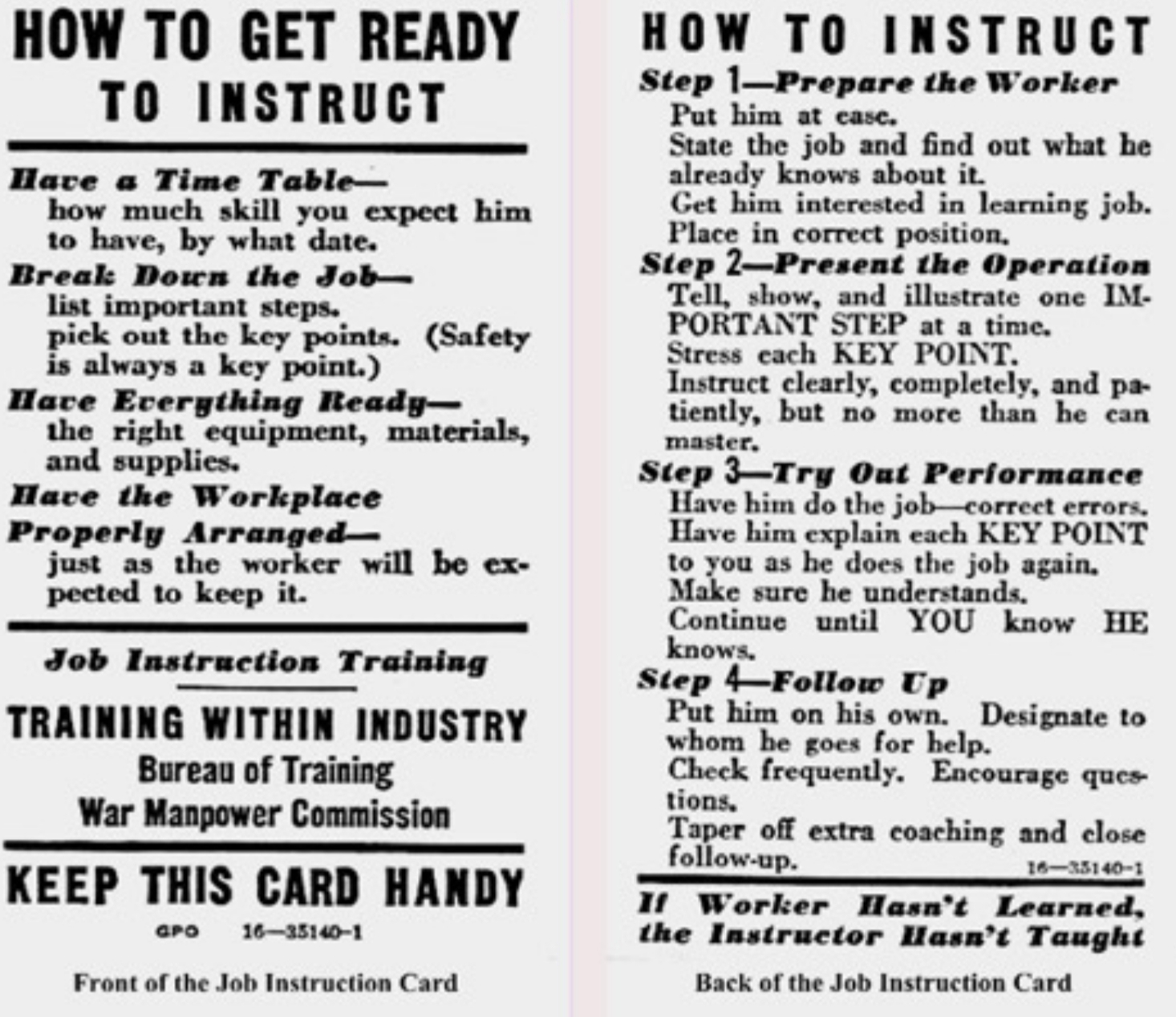

HOW TO GET READY
TO INSTRUCT


Have a Time Table--
   how much skill you expect him to have, by what date.

Break down the job—
   list important steps.
   pick out the key points. (Safety is always a key point.)

Have everything ready—
   the right equipment, materials and supplies.

Have the workplace properly arranged—
   just as the worker will be expected to keep it.


HOW TO INSTRUCT


Step  1—Prepare the worker
   Put him at ease.
   State the job and find out what he already knows about it.
   Get him interested in learning job.
   Place in correct position.

Step 2—Present the operation
   Tell, show and demonstrate one IMPORTANT STEP at a time.
   Stress each KEY POINT.
   Instruct clearly, completely and patiently, but no more than he can master.

Step 3—Try out performance
   Have him do the job—correct errors.
   Have him explain each KEY POINT to you as he does the job again.
   Make sure he understands.
   Continue until YOU know HE knows.

Step 4—Follow up
   Put him on his own.
   Designate to whom he goes for help.
   Encourage questions.
   Taper off extra coaching and close follow-up.

________________________________
If the Worker Hasn't Learned,
The Instructor Hasn't Taught.


Below is an example of the Job Instruction method of teaching a new student how to clean an endotracheal tube after it has been used following our standardized work for the activity.
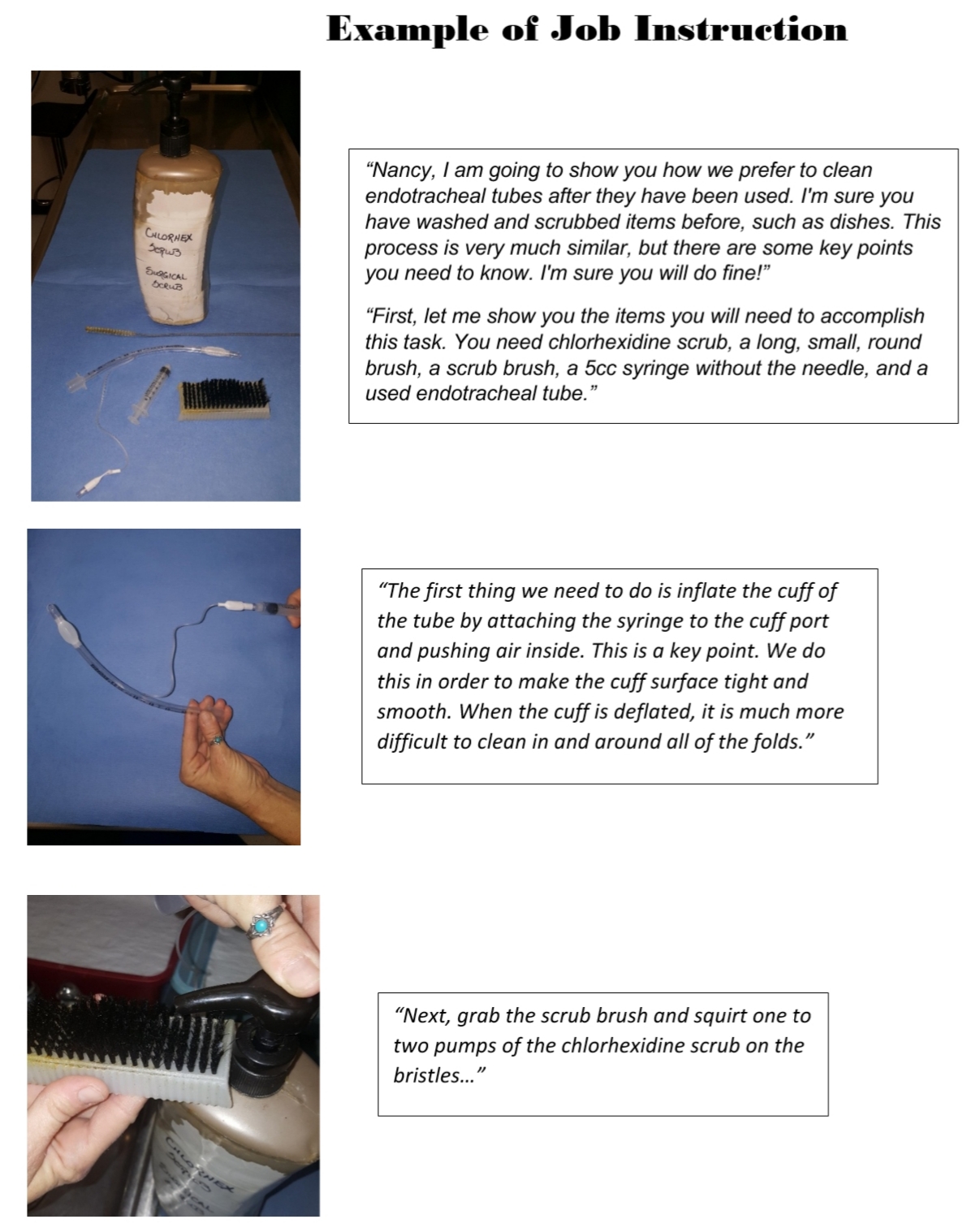
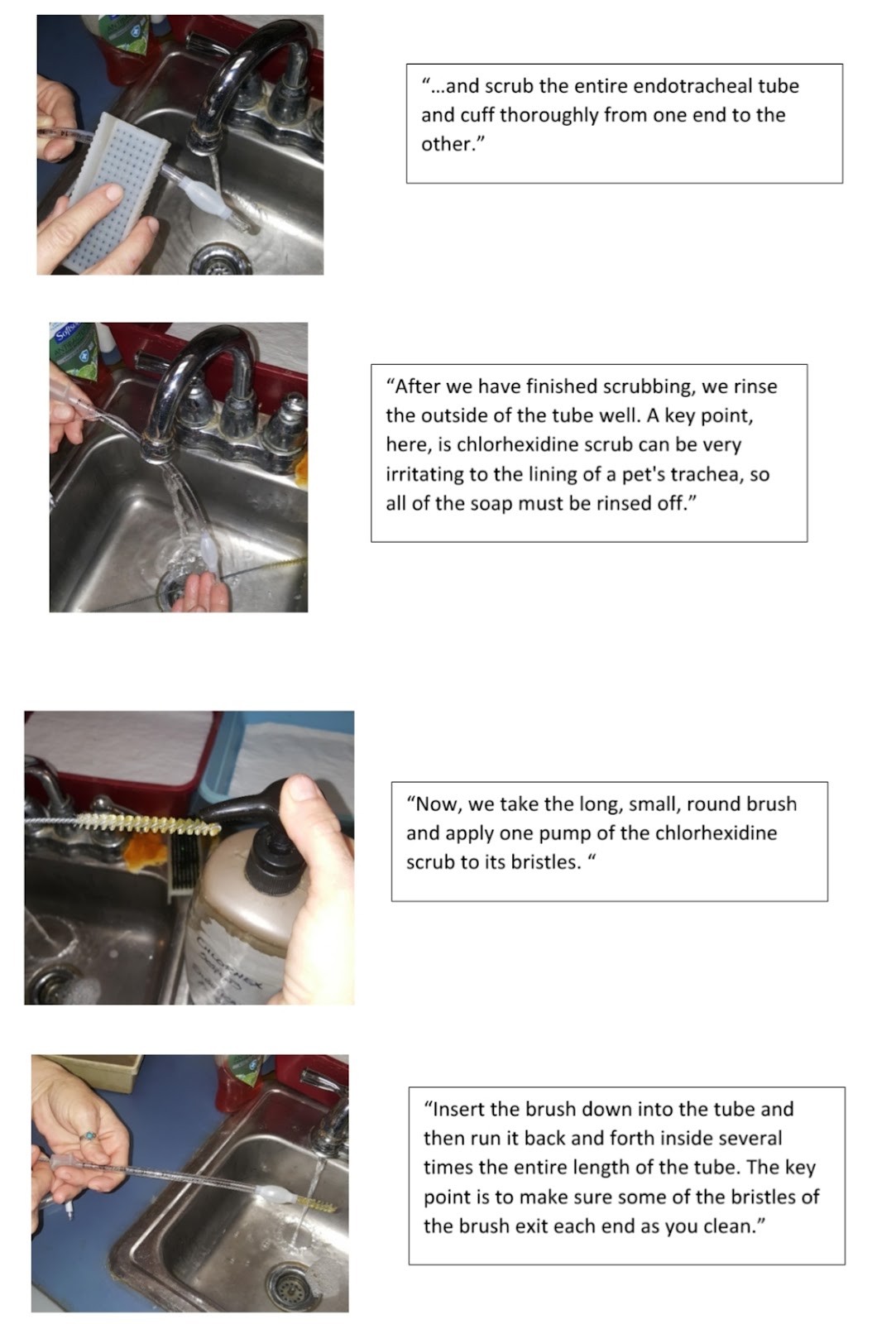
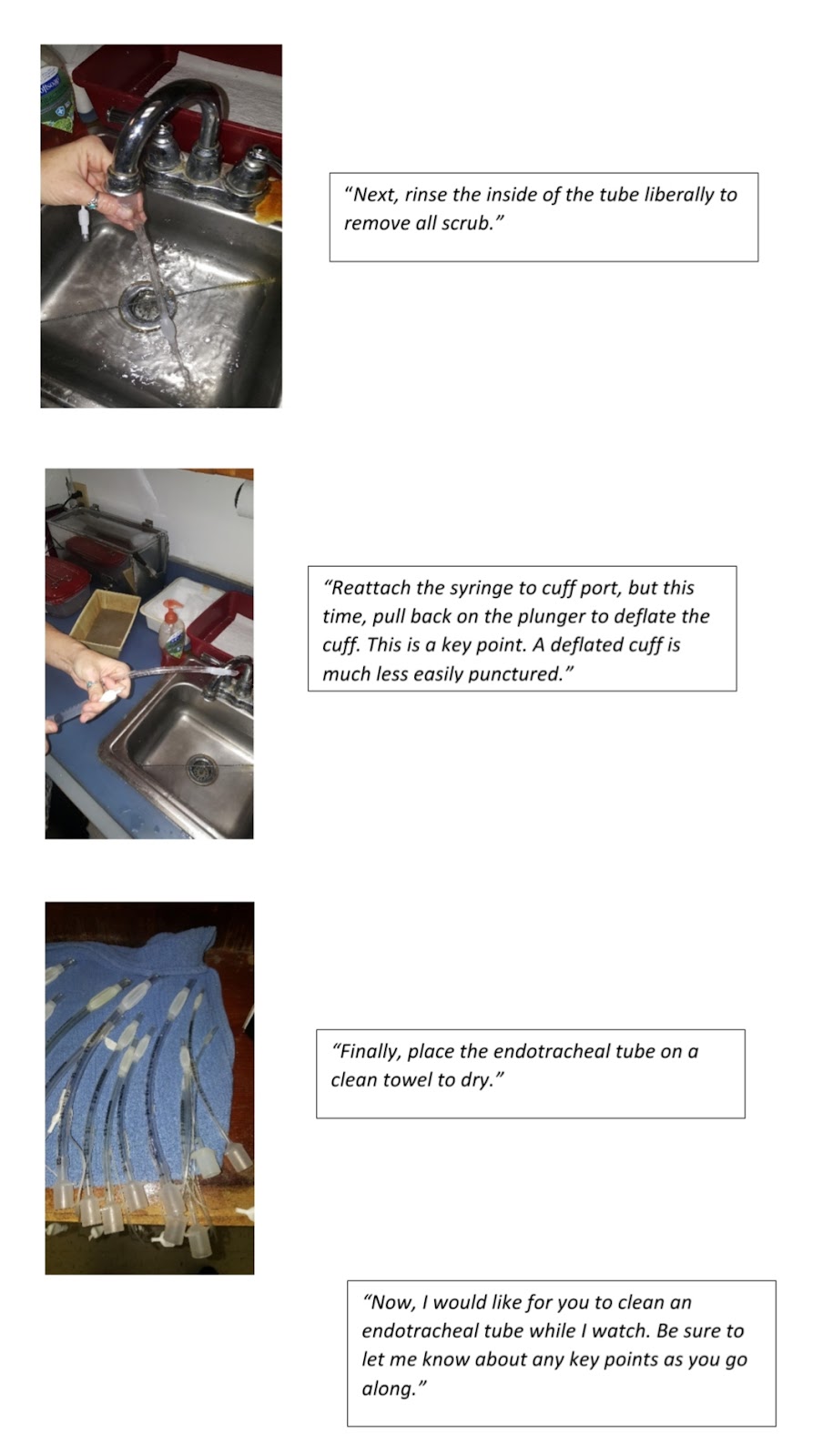
At this point, you can have the student go through the process another time or, if you feel confident of his ability, allow him to work independently. Be sure to praise him for his attentiveness, and give him permission to reconnect with you at any time for any additional assistance he may need.

As explained in the earlier post referenced above, the three TWI J-courses had a major influence on several of key concepts of the Toyota Production System, namely Standardized Work, respect for workers and continuous Improvement. But, true to Toyota’s character, they took that information, put their own “flavoring" on it, and developed what Mike Rother calls Toyota Kata.

Kata comes from  the world of oriental, martial arts. It means “form.” There are two primary kata; Improvement Kata and Coaching Kata. I will look at Toyota Kata in the next post.


Thanks for stoping by. If you enjoy and learn from this blog, please tell a friend or colleague. And, as always, comments always appreciated.

Wednesday, December 20, 2017

A Response To a Comment About My Post "Lean Self"

Last month, shortly after my blog on the “Lean Self”, my friend and mentor Mark Graban posted a comment to that blog. This was unusual.  Usually, Mark emails his questions and points of concern to me after receiving my final draft of the blog post, but before I publish the final, final draft. His questions sometimes come from sheer confusion about what it is ‘that I am really trying to say’, but many times it is his way of teaching in the Socratic (and Toyota) method. That is, rather than lecturing, asking the student a series of questions that lead the student to discovering the answer or reflecting deeper on the subject. Occasionally, I am not sure which it is.

I have decided to answer in another blog post, rather than a reply to the comment that may go unnoticed.

Mark comments:

Thanks for sharing this, Chip.

I agree that having a personal “true north” and understanding your own “current state” can be beneficial.  I don't quite see how to apply the idea of a “value stream” though. What is “value?” How does it flow? How do you see that connection in one’s personal life?

Mark

Here is my response.

Mark, thank you for your comments. Please forgive my tardiness in replying. I have been recovering from a little bit of surgery.

Your questions have caused me to re-evaluate my premise as regards extrapolating the Lean mindset to the “self.” As they should.

What is ‘value’ in this context?
Another way to arrive at an answer to this question is to ask, “What is really important to you in healthcare?” Or, “What is really important to you in a car?” For the “self” it would be, “What is really important to you in your life?” I think (hope!?) for most people it would be “contentment.” To be contented financially. To be content at work. To be content in our relationships.  To be content with ourselves. The Hebrew word “shalom” is generally translated as meaning “peace.” And it does, but it is the peace that comes from being “whole” (content spiritually, physically, emotionally, psychologically); not having excess or being destitute, but from having enough or being grateful with what you do have.

Part of the Lean definition of “value” is that the customer be willing to pay for it. If you are not willing to put a price on what you want, it doesn’t really hold any value. This holds true for the “self”, also. But, it doesn’t necessarily mean money. It means doing the hard work of honest self reflection, letting go of false assumptions, admitting mistakes, mending relationships, simplifying, budgeting, pushing back the ego, stepping out of the forest and,then, prioritizing and starting, somewhere, on a lifelong journey of improvement.

What is the “value stream’?
The Lean concept of the “value stream” requires, amongst other things, a provider, a customer and a “gemba” (the place where the work actually occurs). Unlike other applications of Lean where the provider and customer are separate entities, for the “self” they are the same, us. And the “gemba” is our hearts and minds.

The steps we go through in our hearts, minds and lives to get whatever value we get is the “value stream”. Whether that process results in contentment or “dis-ease” in a particular area of our life depends on how much muda (waste, i.e. faulty thinking, biases, rewritten history, skewed priorities, energy vampires, B**l S**t, etc.) is embedded. Graphically representing this thought process produces a “value stream map”

For example: I must be perfect →  I burned the turkey → I’m a bad cook → I’m a lousy wife → I’m a bad person.  Not good “flow.” Lots of bad processes and “trash.” What’s the value here?

Note that using 5 Why might take you back through this process. For example:
     Why are you a bad person?  Because, I am a lousy wife.
     Why are you a lousy wife? Because, I am a bad cook.
     Why are you a bad cook? Because, I burned the turkey AND I must be perfect!
BINGO!! A possible root cause. The false belief that “I must be perfect!”!

Now, to be able to map this current state value stream may not be easy and it may require the help of “stakeholders” (others who have our best interest at heart). And, just as in any other Lean application, finding the “waste” in order to produce a better future value stream will work best if our “stakeholders” are given access to our gemba and are present; if we are open, honest and communicative about what is going on inside of us and in our lives.

Thus, I think the Lean concepts of value, true North, gemba, current value stream, future value stream, A3 thinking, 5S, 5 Why and kaizen are just as valid working on improving ourselves as it is in improving manufacturing, service industries, healthcare, etc. for the customer- us!

Wednesday, June 28, 2017

Sayings of the Lean Fathers


Within the body of Jewish literature,  there is a book called "Pirke Avot", which means 'Sayings of the Fathers'. It is a collection of wisdom and quotes handed down from the ancient rabbis and the Jewish tradition. Taking that reference as a model, I decided to produce this "Sayings of the Lean Fathers." Enjoy!

Taiichi Ohno

(February 29, 1912 – May 28, 1990) was a Japanese industrial engineer and businessman. He is considered to be the father of the Toyota Production System, which became Lean Manufacturing in the U.S. He devised the seven wastes (or muda in Japanese) as part of this system. He wrote several books about the system, including Toyota Production System: Beyond Large-Scale Production.   https://es.wikipedia.org/wiki/Taiichi_Ohno 

We are doomed to failure without a daily destruction of our various preconceptions.

Progress cannot be generated when we are satisfied with existing situations.

Start from need.

Having no problems is the biggest problem of all.

If you assume that things are all right the way they are, you can’t do Kaizen. So change something!

Ask 'why' five times about every matter.

Why not make work easier and more interesting, so people do not have to sweat? The Toyota style is not to create results by working hard. It is a system that says there is no limit to people’s creativity. People don’t go to Toyota to ‘work’, they go there to ‘think’.

Without standards, there can be no improvement.

Where there is no Standard there can be no Kaizen.

Standards should not be forced down from above but rather set by the production workers themselves.

Make your workplace into showcase that can be understood by everyone at a glance. In terms of quality, it means to make the defects immediately apparent. In terms of quantity, it means that progress or delay, measured against the plan, is made immediately apparent. When this is done, problems can be discovered immediately, and everyone can initiate improvement plans.

The slower but consistent tortoise causes less waste and is more desirable than the speedy hare that races ahead and then stops occasionally to doze. The Toyota Production System can be realized only when all the workers become tortoises.

All we are doing is looking at the time line, from the moment a customer gives us an order to the point we collect the cash. And, we are reducing the time line by reducing the non-value-added wastes.

Something is wrong if workers do not look around each day, find things that are tedious or boring, and then rewrite the procedures. Even last month's manual should be out of date.

The more inventory a company has, the less likely they will have what they need.
We are doomed to failure without a daily destruction of our various preconceptions.

The key to the Toyota Way and what makes Toyota stand out is not any of the individual elements…But what is important is having all the elements together as a system. It must be practiced every day in a very consistent manner, not in spurts.

If you are going to do TPS you must do it all the way. You also need to change the way you think. You need to change how you look at things.

The only place that work and motion are the same thing is the zoo where people pay to see the animals move around.

People who can’t understand numbers are useless. The gemba where numbers are not visible is also bad. However,  people who only look at numbers are the worst of all.


Taiichi Ohno. (n.d.). AZQuotes.com. Retrieved June 16, 2017, from AZQuotes.com Web site: http://www.azquotes.com/quote/731341
https://www.slideshare.net/mobile/optimaltransformation/a-collection-of-quotes-from-taiichi-ohno
Https//www.inspiringquotes.us/author/2150-taaichi-ohno


W. Edwards Deming

(October 14, 1900 – December 20, 1993) was an American engineer, statistician, professor, author, lecturer, and management consultant. Educated initially as an electrical engineer and later specializing in mathematical physics, he helped develop the sampling techniques still used by the U.S. Department of the Census and the Bureau of Labor Statistics. In his book, The New Economics for Industry, Government, and Education, Deming championed the work of Walter Shewhart, including statistical process control, operational definitions, and what Deming called the "Shewhart Cycle" which had evolved into PDSA (Plan-Do-Study-Act). This was in response to the growing popularity of PDCA, which Deming viewed as tampering with the meaning of Shewhart's original work. Deming is best known for his work in Japan after WWII, particularly his work with the leaders of Japanese industry.    https://en.wikipedia.org/wiki/W._Edwards_Deming

People are entitled to joy in work.

Management by results -- like driving a car by looking in rear view mirror.

It is not necessary to change. Survival is not mandatory.

The greatest waste in America is failure to use the abilities of people.

The moral is that it is necessary to innovate, to predict needs of the customer, give him more. He that innovates and is lucky will take the market.

The consumer is the most important point on the production-line.

Export anything to a friendly country except American management.

Whenever there is fear, you will get wrong figures.

A bad system will beat a good person every time.

To manage one must lead. To lead, one must understand the work that he and his people are responsible for.

Does experience help? No! Not if we are doing the wrong things.

The supposition is prevalent the world over that there would be no problems in production or service if only our production workers would do their jobs in the way that they were taught. Pleasant dreams. The workers are handicapped by the system, and the system belongs to the management.

Defects are not free. Somebody makes them, and gets paid for making them.

Every system is perfectly designed to get the results it gets.

A leader is a coach, not a judge.

Pay is not a motivator.

The merit rating nourishes short-term performance, annihilates long-term planning, builds fear, demolishes teamwork, [and] nourishes rivalry and politics. It leaves people bitter, crushed, bruised, battered, desolate, despondent, dejected, feeling inferior, some even depressed, unfit for work for weeks after receipt of rating, unable to comprehend why they are inferior. It is unfair, as it ascribes to the people in a group differences that may be caused totally by the system that they work in.

Quality is made in the board room. A worker can deliver lower quality, but she cannot deliver quality better than the system allows.

http://quotes.deming.org/authors/W._Edwards_Deming


Shigeo Shingo

 (1909 - 1990), born in Saga CityJapan, was a Japanese industrial engineer who is considered as the world’s leading expert on manufacturing practices and the Toyota Production System.      https://en.wikipedia.org/wiki/Shigeo_Shingo

Lean is a way of thinking- not a list of things to do.

The most dangerous kind of waste is the waste we do not recognize.

Are you too busy for improvement? Frequently, I am rebuffed by people who say they are too busy and have no time for such activities. I make it a point to respond by telling people, look, you’ll stop being busy either when you die or when the company goes bankrupt.

Unless you change direction, you will end up where you are headed.

We have to grasp not only the Know-How but also 'Know Why', if we want to master the Toyota Production System.

Those who are not dissatisfied will never make any progress.

There are four purposes of improvement: easier, better, faster, and cheaper. These four goals appear in the order of priority.

A relentless barrage of 'why’s' is the best way to prepare your mind to pierce the clouded veil of thinking caused by the status quo. Use it often.

Shigeo Shingo. (n.d.). AZQuotes.com. Retrieved June 18, 2017, from AZQuotes.com Web site: http://www.azquotes.com/quote/731329


Masaaki Imai

(born, 1930) is a Japanese organizational theorist and management consultant, known for his work on quality management, specifically on Kaizen.     https://en.wikipedia.org/wiki/Masaaki_Imai

The message of the Kaizen strategy is that not a day should go by without some kind of improvement being made somewhere in the company.


The Kaizen Philosophy assumes that our way of life - be it our working life, our social life, or our home life - deserves to be constantly improved.

It is impossible to improve any process until it is standardized. If the process is shifting from here to there, then any improvement will just be one more variation that is occasionally used and mostly ignored. One must standardize, and thus stabilize the process, before continuous improvement can be made.

Progress is impossible without the ability to admit mistakes.

The standard is not written on the stone. The definition of the standard is that it is the best way to do the job for now. It should be regarded as a next step to make further improvement.

Where there is no standard, there can be no improvement. For these reasons, standards are the basis for both maintenance and improvement.

Kaizen means ongoing improvement involving everybody, without spending much money.

I believe that management should focus on two particular areas. One is Gemba (shop floor) and the other is customer (not the shareholder).

You can't do kaizen just once or twice and expect immediate results. You have to be in it for the long haul.

All of management's efforts for Kaizen boil down to two words: customer satisfaction.

I have a theory that among the large Western companies (mostly American) the higher an executive is promoted, the more wisdom is lost and by the time he or she reaches the top becomes a complete idiot. Certainly they do not deserve the outrageous salary.

Japanese management practices succeed simply because they are good management practices. This success has little to do with cultural factors. And the lack of cultural bias means that these practices can be - and are - just as successfully employed elsewhere.

Kaizen is like a hotbed that nurtures small and ongoing changes, while innovation is like magma that appears in abrupt eruptions from time to time.

Under the lean system, any tools which are required for solving problems are used.

Masaaki Imai. (n.d.). AZQuotes.com. Retrieved June 18, 2017, from AZQuotes.com Web site: http://www.azquotes.com/quote/1555116

Final Thoughts


Can you recognize some themes here? Do any of this quotes resonate with you? Maybe one or more hits a little closer to home?! Which ones are you going to take with you and/or share with others? Did any challenge your previous mindset?


Thanks for stopping by. Tell your friends about us and, please, leave any comments and questions you may have.

Thursday, June 8, 2017

Lean and Veterinary Medicine: Like a Glove


After reading, studying and thinking about Lean over the past seven years, I am convinced that Veterinary practice and Lean are destined for each other. As veterinarians and systematic problem solvers, we already know and are familiar with over eighty percent of Lean; we just don’t know it. Lean promotes greater value for the customer (from the customer’s perspective), with higher quality, better utilization of all resources  (especially our human resources), less expense and increased engagement of staff. I think most veterinarians want the same things.

Lean is the Western name for the Toyota Production System (TPS). Coined for its ability to remove the “fat” (wastes or muda) from processes.  Toyota developed TPS in an effort to rise out of war torn Japan, with its limited resources, to be able to go beyond truck manufacturing for the small, Japanese economy to complete with the American auto giants in a global economy. Since then, most other industries have found successes with Lean, including human healthcare. Can it do for veterinary medicine what it has done for many hospitals and healthcare system around the world? I think it can and that we need to try.


We’re Not That Different, Really

First of all, Lean takes a systems approach to problems. Problems are examined from a systems breakdown perspective before people are blamed. Lean asks “Why did this happen?”, or “How did this happen?” as opposed to “Who is responsible?” As doctors, we work with systems in our patients every day. We understand inputs, outputs, delays and feedback loops, both positive and negative. We know what can happen when one system is changed and how it can affect other systems for the better or the worse.

In order to identify the abnormal, we must first understand what is normal; what is ideal for this species, breed or animal. In veterinary school, we learned normal anatomy and physiology before we studied pathology. The same concept is true for Lean. We must have a very clear idea of what our ideal practice would look and function like. Notice, that I did not say an ideal practice. Lean is not trying to make your practice some management guru’s idea of the perfect “cookie cutter” practice. Lean understands that your practice is unique. The doctors are different. Their biases, philosophies and perspective are unique. The neighborhood where your practice is located is different than other neighborhoods. The mix of your employees is one of a kind. The Lean objective is to make your practice the best “your” practice it can be, now and into the future.

In the Lean mindset, this ideal is called our “True North.”  What would your practice look like if it was perfect? How would your practice perfectly relate to your clients? What would your ideal staff look and function like? How would your practice benefit your neighborhood and community if it is was perfect? It’s totally up to you. What ever you decide your True North is, Lean is designed to get you there. Forget, what a “Top 100 Best Practice” says you should be. What is important from the Lean perspective is that you are closer to your True North today than yesterday; closer this month than last month.  The perpetual destination of the Lean journey is perfection, knowing full well, of course, that this is impossible. The Lean journey never ends. As Vincent Lombardi said, we pursue perfection, knowing we will never get there, in order to reach excellence.


We Know This

As veterinarians, we are already quite familiar with eighty percent, or more, of the Lean methodology. We just don’t know it. Both mindsets are based on the scientific method of problem solving.

When a sick pet comes into our practice, health is our goal, our ideal state. The first step in diagnosing that pet is to understand fully the current state of that patient. We start with the primary client complaint. Regardless of whatever else we discover, we want to make sure we address this problem. Next, we collect a complete history; vaccinations, diet, current medications, symptoms and their progression, etc.

The second step is to perform a complete “tip of the nose to tip the tail” physical exam, paying particular attention to the client’s primary complaint. Can you imagine trying to make a diagnosis without performing a physical exam on the patient?

Next, we might perform diagnostic tests, such as a complete blood count, a general organ profile, urinalysis, radiography, and specific serology tests. We are attempting to explain why the patient is having the symptoms it is having. Medicine is based on facts, objective data, not fantasy.

At this point, we should have a reasonable understanding of the pet’s current state of health. Now, because we know what the ideal state of health is for this species, breed, gender and age, we can identify the problems; the gaps between our patient’s current state and the ideal state.

Based on our problems list, we formulate a treatment plan. This is an experiment. We don’t know if our treatments will work, but we decide, maybe with consultation with colleagues and specialists, what we are going to do. Later, we will follow up with the client and pet in order to analyze if we were successful  at reaching our ideal state of health. If we were successful, we will set a time for the next review, maybe in six months or a year. Remember the 3Rs; Recall, Re-examine or Reminder? If we were not successful, we reflect on what went wrong and start the process over again with additional history, another, possibly more in depth, physical exam, additional tests, a second, adjusted round of treatments (another experiment) and another analysis of the outcome.

As I said, the Lean methodology of management problem solving is also based on the scientific method. The process is almost identical to the one described above for diagnosing and treating sick pets. So how do we know we have problems? Because we have not reached our ideal state in one form or another.

The first step in Lean problem solving is to thoroughly define and understand our current state, just as it was with our patient. This step might include past and current metrics; key performance indicators. What is our story? “The facts, ma’am, only the facts!”

Defining the current state also includes an essential “physical exam.” In Lean, this is called “going to gemba.” Gemba is the Japanese word for the work floor, the place where the work (and problem) actually occurs. For instance, if the problem has to do with surgery, then the surgery room is the gemba. Lean emphasizes the importance of physically observing the flows and processes (the “value stream”) in real time in order to deeply understand the current state as it really is. A big difference in the Lean mindset, however, is that this observation (physical exam) should take place with the staff that are there on the floor, because they know better than anyone what the real issues are. They deal with it every minute of every day. They are an organization’s most valuable asset and resource, especially for helping to identify and provide solutions to problems. Lean promotes partnering with employees in this effort. Our staff wants to be part of the process of finding solutions, rather than always being seen as the cause of problems. This is a big part of what engages them.

Now, as in the diagnostic process, we can identify the gaps between our current state (disease) and our True North (health). However, many problems can appear to be caused by a particular cause when, in fact, it is caused by something much deeper; something more basic. Just as not diagnosing and treating the real problem versus treating symptoms will probably not yield a cure for or patients, not solving problems at their root cause will not provide a permanent solution to the problem at hand.


So, in Lean there is a “diagnostic” called “5 Whys.” This is the idea that one should ask “why” five times to insure the root cause has been identified. A fix for anything less will not solve the problem once and for all. The number five is somewhat arbitrary. It could be four or it could be seven. The idea is to ask enough times that the root (absolute) cause has been identified.

Does it ever seem like you are having to deal with the same problems over and over again? As if you are constantly playing the game “Whack-A-Mole?” As soon as you think a problem has been squashed in one place, it “pops up” again somewhere else? One of the main reasons for this could be the fact that the root cause (the definitive diagnosis) has not been found (another reason could be that your unique, valuable and knowledgeable staff played no part in the process). That it has always only been handled with “Band-Aids.” And, all of this effort is found to be just a waste of time and effort.

Once we know the gaps between our current state and our ideal state, we, in dialogue with our staff,  can devise the counter measures (treatments) we feel are indicated. This is an experiment, also, since we don’t know if it will work. It will give us an idea of what the future state should look like. Since our True North, or ideal state, is perfection, and we know that is impossible,  then the best we can do is aim for the next, improved, future state. Lean is a journey that never reaches its final destination of perfection. It is the process of continuous improvement toward ever better future states. We can never reach our True North, but with constant effort, we can get really, really close!

The final step, as with our patients, is to study the results of our tiny experiments. If the results are positive, then we institute it as the new, best method or standardized work and the staff is trained to this new current state. We will continually, from time to time revisit this process in order to improve it  even more down the road. If our “treatments” does not turn out well, then we (along with staff) will make adjustments and start the whole process over again with different countermeasures and experiments.
I hope it is evident, now, how much diagnosis and treating patients in our veterinary practices is similar to the Lean methodology of management and problem solving. I told you that you knew more about Lean than you realized!


SOAP vs PDSA

We are all familiar with the SOAP format for writing medical record. “S” stands for “Subjective, “O” stands for “Objective”, “A” stands for “Assessment” and “P” stands for “Plan.” The Subjective and Objective parts define the current state of the patient. Assessment delineates our tentative diagnosis. Plan communicates our, hopefully, successful treatment. It is not the medical record that is so important. It is the diagnostic thought process that is important. We could write medical records with a different format, but the thought process is the same, regardless.

In Lean, the written document is called an A3 report because it was written on an A3 sized (approximately 11 inches by 17 inches) piece of paper which was the largest paper that would fit in a fax machine at the time. It is based on the Deming (named for the American, W. Edwards Deming, one of the first to use statistics for quality control and improvement) or PDSA cycle that is the thought process.


“P” stand for “Plan.” In this part of the report (which typically occupies about 50% of the entire report), we provide a statement of the problem, any 5 Why analyses, the necessary information (e.g. data, charts, graphs, Value Stream maps, etc.) to describe our current state, possibly a Future State map, and any cost estimates relevant to the experiment . 

Following is the “D” or “Do” section. This section delineates the proposed countermeasures we will experiment with. 

Next is the "C" or "Check" (some use “S” or “Study”) portion of the report. Here, we explain and study the results of the experiment. 

The final section is the “A” section which stands for “Act” or “Adjust.” Here, we reflect (hansei) on the results of our experiment. If it was successful,  then we act on the results by instituting them within the practice. If not, we adjust, come up with new countermeasures and experiments in a new PDSA cycle and A3 report. Again, it is not the format of the report that is important (although the idea that everything should be concise enough to fit on one A3 sized paper is an important aspect), it is the process (called A3 thinking) that is.

Because the diagnostic process and Lean problem solving are both based on the scientific mindset, both reports are similar. More that we didn’t know that we know!


Thanks for visiting. Tell your friends about the blog!


Tuesday, September 6, 2016

Einstein's Equation of Lean Relativity


No, not Albert Einstein! Moraito “Morey” Einstein, Albert’s third cousin, twice removed on his mother’s side.

Just kidding! However, this, in a simple equation, explains Lean.

“F” stands for Flow and “V” stands for Value from the client’s point of view.

Taiichi Ohno’s equation states:

                                      Capacity = Work + Waste

What this equation states is that there is always waste in our current state. When we remove some waste, we create a new current state, but there is still waste. We pursue perfection, but never achieve perfection.

If we substitute our total “Value Streams” for “Present Capacity” and “Flow” for “Work”, we get:

                                     Value Streams = Flow + Waste

Rewriting the equation gives us:

                                     Flow = Value Streams - Waste


This, then, is essentially what flow means. Flow is all the different processes (value streams) that occur in the management of a veterinary practice with as much waste removed as possible (and then continually improved).

Also, remember that Value is defined as that which a client desires (Dc) and is willing to pay for, that moves (Mp) the patient's condition toward the desired outcome and is performed correctly (without waste; W) the first time.

                                           V = Dc + Mp - W


Everything about Lean is about improving flow, because flow ultimately results in greater value. A3 problem solving, 5S projects, kanban, Just-In-Time (JIT) concepts, error proofing (jidoka), visual management, continuous improvement (kaizen), everything is aimed at pursuing the perfection of flow. We continually improve systems and processes in order to improve flow, and therefore, value. 5S organizes the hospital by removing clutter from work areas, organizing the areas so that they have only the needed equipment close to hand with a consistent place for everything and everything in its place. 5S also makes problems visible, and solving those problems allows us to improve flow.

For example, at our hospital we were constantly having to leave the exams rooms to find this or that item. Not good for flow! So, we went to each of the exam rooms and got rid of duplicate suture scissors, hemostats, tourniquets, etc. Then, the staff and I created a list of the supplies and instruments that we routinely use within the rooms. We chose a roll of tape, Vetrap, cotton swabs, gauze squares, clippers, a small supply of various syringes, a digital thermometer, a Nye tourniquet, a stethoscope, fecal loops, etc. We even put some blood tubes, Idexx spinners, and a bottle of heparin in each room to facilitate quick blood draws for lab tests. Finally, we organized the drawers so that they were the same in each exam room. Now, each room is the same, with the most used resources close at hand. In addition, we all now know, regardless of which room we’re in, that tape is in the right hand drawer and the tourniquet is in the left. There is less confusion. We don't have to think, “This is exam room 1, so the suture scissors are here...no, there...no, in that drawer.” There’s no more time spent searching for items. Also, doctors and/or staff can now quickly (visually) tell if the drawers are complete (standardized). If not, the problem is fixed right then so it doesn't continue to be a disruption. This improves flow, thus value.

Kanban and JIT improve resource utilization by creating a system that provides drugs, supplies, staff schedules and doctor’s time, to name a few, only when needed, where needed and in the amount needed. This frees up cash, space, staff and doctors to do more patient care which improves flow which equates with higher value. Visual management techniques, A3 (PDSA) thinking, and “5 Whys” root cause analysis allow problems to be easily seen and fixed at the root cause(s), again, in order to improve flow and value. Even kaizen, the concept of utilizing our ultimate resource, our staff, to identify and fix problems and remove waste (muda) from our value streams is for the purpose of perfecting flow.

Time is money. And, time spent on wasteful activities and processes is money lost. Everything in our hospital, even wasted items, has to be paid for through income from clients. Otherwise, it comes out of our pockets, our bottom line. Value from the client's perspective means not being charged higher fees in order to cover waste.


All of this, then, is contained in the equation F=V. Simple, right?

The different individual concepts and “tools” of Lean are relatively simple. The difficulty is conceptualizing how the different elements interrelate to create Lean, putting it into operation within your practice and, then sustaining it long enough to get positive results and change the organizational mindset to automatically think Lean. But, that is a different equation and a different blog!

For now, just remember, “it's all about da flow, ‘bout da flow, ‘bout da flow…!“

What are your thoughts? Let us know.

Saturday, February 20, 2016

Root Cause Problem Solving and The 5 Whys

Do you ever feel like you’re playing a game of “Whack-A-Mole?” The same problems, previously thought to be solved, keep popping up in different areas of your practice at different times. One of the reasons may be that the root cause of the problem has not been identified and dealt with effectively. Lean offers a number of solutions to this situation.

Toyota uses a method called “Practical Problem Solving” or 8-Step Problem Solving, that provides a structured way to investigate and solve problems.

These steps are, as mapped to the PDSA cycle:

Step #                      Step                         PDSA Phase
1                  Clarify the problem              Plan
2             Break down the problem
3                   Target setting      
4               Root cause analysis
5          Develop countermeasures
6       See countermeasures through        Do
7  Monitor the results and processes      Study
8   Standardize successful processes      Adjust

In step 4, one method for root cause analysis is called “The 5 Whys,” which suggests that you ask “why” five times, sequentially, in order to find the root cause.
Why does that problem occur? Why is that? We keep drilling down deeper, rather than just answering the original why five different ways.

The number five is somewhat arbitrary - it’s not always five whys that are required. The idea is to ask enough times to get to a root cause or causes, to get beneath the surface of a problem. Once suspected root cause(s) are identified, countermeasures can be tested and, if they are effective, standardized work can be updated or written to prevent recurrence. It is important that this take place at the gemba, where the problem occurs, with all stakeholders present in order to build consensus about an appropriate countermeasure to test.  If, at this point, you continue to have recurrences of the same problem, then it’s possible that the correct root cause was not identified, or there’s a different root cause this time, or standards that have been put in place are not being followed.

For example, at a large animal veterinary clinic, there was a hydraulic rotating machine that was used to turn cows on their side for treatment. One day, there was some hydraulic fluid on the ground near the machine. The tech noticed this and, instead of just cleaning up the grease, she stopped to investigate. We can start asking why:

Why was there fluid on the ground? Because the hydraulic cylinder had stopped working.
Why had the hydraulic cylinder stopped working? Because the filter was clogged.
Why was the filter clogged? It had not been changed in a long time.
Why hadn’t it been changed in a long time? There was not a standardized work method for doing so. 

There were not clear roles and responsibilities, nor was there a standard changing frequency.
So, instead of just putting out the fire and replacing the filter, a Lean organization would look for a more systemic cause and countermeasure. Not having standardized work could have caused the machine to fail in a catastrophic way, possibly harming an animal or a tech. Just replacing the filter would not have fixed the process in a root cause to prevent the same problem from occurring in the future. Asking “why?” and digging deeper allowed the tech and engineering to come up with a better solution.


Monday, November 9, 2015

A New Paradigm For Veterinary Practice Management

 
There is a new paradigm, a new methodology, with proven results over many different industries including human health care. The new model is the Toyota Production System (TPS), better known in the West as Lean, for its consistent ability to deliver both quality and value without the waste and frustration that we see in so many organizations.


Over the course of 70 years, Toyota has grown from being a small, domestic, truck manufacturer in a devastated post-war Japan to being the largest auto maker in the world, for a time in 2012, even surpassing America’s industrial revolution icon, Ford Motor Company. Additionally, they have been profitable in every one of those years except three. How has Toyota been able to accomplish such milestones? By relentlessly pursuing a strategy of operational excellence, which includes a leadership style and organizational culture that is very different than most companies.


Lean is not just a set of tools. Toyota’s own website describes their production system as being a combination of:

  1. Technical tools and methods
  2.  Management methods
  3. Philosophy and mindsets 

Practiced together, this results in an organizational culture that develops people in the organization and sets up the organization for long-term success. Toyota also emphasizes that the main goals are improving flow (in the case of healthcare, providing the right care at the right place at the right time) and ensuring quality at the source. There is a foundation of safety being a top priority (for patients and employees) instead of being a separate program or initiative. 


            Toyota also described their “Toyota Way” management system as having two key pillars:

Being respectful in the workplace is not just a matter of being nice. It means challenging people in a constructive way so they can grow and perform to the best of their ability. “Respect for people” is a phrase that is also sometimes expressed as “respect for humanity.” This means not just showing respect for all stakeholders (such as customers, employees, suppliers and the partners, the community), but also respecting our human nature. For example, Lean leaders understand that we have human limitations, such as making more errors when we get distracted or are physically or mentally exhausted. This drives us to error proof systems to help prevent common human errors, rather than just asking people to be careful.


In the Lean framework, operational excellence is based concepts, such as the following:

  1. Value (http://www.leanvets.com/2016/02/value.html) is defined from the customer’s point of view.
  2. Work relentlessly to reduce or eliminate waste (http://www.leanvets.com/2016/01/in-japanese-word-for-waste-is-muda.html).
  3. Build a culture of continuous improvement.
  4. Standardize work to improve flow.
  5. Make problems visible and react quickly.
  6. Understand problems and solve them at their root cause(s).
  7. Demonstrate deep respect for workers and all stakeholders. 

Successful practices realize that long-term success comes from satisfied clients. Clients should truly feel we have their best interests at heart. Hopefully, they would choose our practice not necessarily because we are less expensive than another practice, but that they received value for the hard-earned money they spend with us. We are responsive to their desires, and we value their time as much as we value ours. Satisfied clients help resurrect the idea of positive, direct ”word of mouth" advertising.